(Essay)
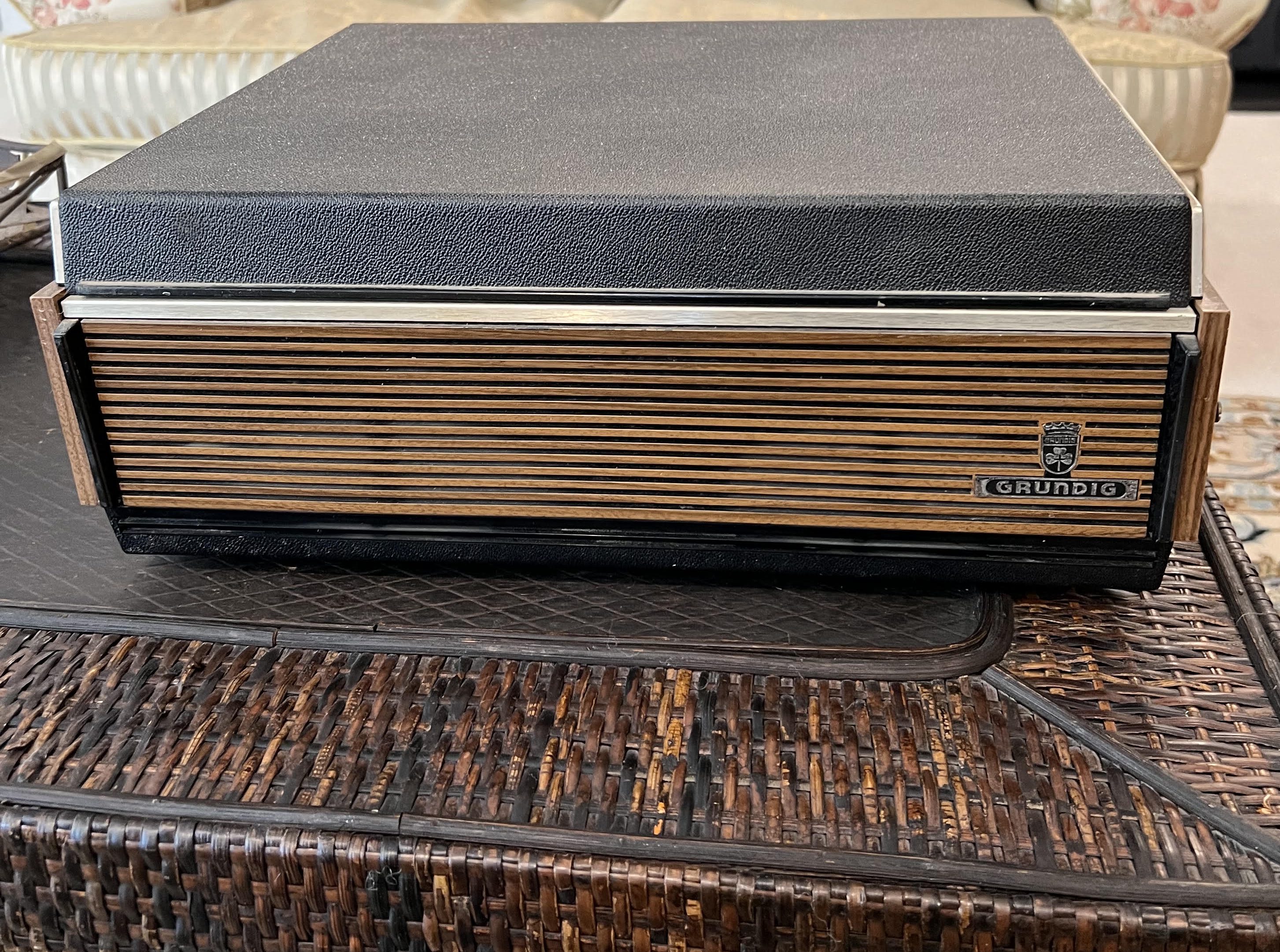
The Ring camera from the front door notified me that a person was picking up a bulky item and walking away. The “bulky” item was our Grundig reel-to-reel tape recorder/player. I had kept it outside the front door of my house to be picked up by a charity. When I had called them to ask if they would be interested in the antique Grundig, the representative had agreed that they indeed would be interested in the player if it was in good condition. I had tested it a couple of years ago, and it worked. Still, I was not sure the person who came to our door would pick it up, for whatever reason. Therefore, I was happy that he did pick it up. It was finally gone.
I cannot say for real that I was glad it was gone. We had owned the player for more than fifty years. It was a beloved possession. It was July 1972 when we bought it. July is the month of our wedding anniversary. That year it was the second anniversary. Being newlywed, we had resolved that for each anniversary we would buy something memorable for our house. A record player to play Indian songs was a good choice. Friends recommended that a Grundig reel-to-reel record player would be a good investment.
Most people of Indian origin, including us, hoped at that time that they would eventually go back to India. An appliance that would work with dual voltages (110/220 V) and dual frequencies (60/50 Hertz) was preferred. We had heard that there was a store called ABC Trading Company on Canal Street in lower Manhattan that was famous for selling such items.
I remember taking the subway from Forest Hills in the borough of Queens, New York, to Canal Street.
The ABC was a small store, about the size of a 30 ft by 40 ft room. As one entered the shop, one faced a wall-to-wall counter. Behind the counter, there were a couple of bearded men in traditional Hasidic Jewish attire. The store would always be very crowded, like a busy railway platform. People stood, clustered along the counter, two or three people deep. One had to hustle and try to get in the front to talk to the salesman. There was no time to bargain. There was a huge demand for small appliances, electronics, Melmac cooking ware, gold buscuits and travel gear. One could see the joy on the faces of the people departing the store as if they had won a lottery when they got what they wanted.
As Bharati and I entered the store, there were people standing in front of the counter bargaining with the person on the other side, even though it was a futile attempt. I did not know how long it would take me to be at the counter. Should we wait our turn or just push our way through? I was not the type to push my way through. We waited and moved as space became available. We finally reached the counter.
“What do you want?” asked the person in a gruff voice.
With his long beard and not-so-friendly demeanor, he was a bit intimidating.
“Do you have the Grundig reel-to-reel tape recorder that will work in India and here?” I asked
“Yes.” He replied.
He pointed to the back of the store, near the entrance. There was an open box with the name Grundig. I asked if it was new.
“Yes, yes,” he said as if he didn’t have much time for me.
I bought it for $205. It was a Grundig model TK 248 U, with a rectangular wood box-like surround and a black top. It weighed roughly 28 pounds. It never occurred to me that someone could have returned it, and that’s why it was an open box.
Happy to own a recorder, we brought it to our apartment in Queens. We read the operating manual. It was easy enough to use. There used to be an Indian language program on a local radio station that played Indian songs. Bharati recorded many. We enjoyed listening to them and were glad of our purchase.
A few weeks later, the recorder stopped working. It had to be under warranty, so I thought. We hauled it to the ABC store. The person said he would take care of it. We had to leave it with him.
Days later, we made another trip to lower Manhattan to bring it back. Again, the recorder stopped working after a few weeks. We were beginning to feel like we had bought a lemon.
Luckily, a new shop had opened near our apartment that advertised that they repaired electronic instruments. We didn’t have to haul it to Manhattan. This time they did a good job. The tape recorder did not break again. We enjoyed listening to songs we had recorded.
In 1975 we moved from our apartment in Queens to a small split-level house on Long Island. After living there for 18 years, my company relocated us to Northern Virginia, and then after almost thirty years in Virginia, we moved to Ellicott City, Maryland. The Grundig stayed with us through all these moves. Before moving to Maryland, we were in a downsizing mode and cleared up our possessions that had accumulated and were not used. As the technology changed, we acquired cassette tapes and discs with music. The poor Grundig recorder just stayed in a corner, rarely used. We thought of disposing of it before our move to Maryland. We were not sure if it still worked. It had been a while since we had used it. Lo and behold, when we plugged it in and turned it on, the reel began spinning. The melodies of old songs filled the air. We decided to keep it. It came with us.
“It works. Let’s keep it,” we said. “We can use it at a party or some such occasion.”
One year, not so long ago, during Christmas, we were gifted the latest technological invention, the Alexa. A small round hockey-puck-sized device that was to be plugged into a wall outlet. We just had to give a command like: “Alexa, play the songs of Mukesh,” for example. Within seconds, Mukesh’s song would start playing.
Suffice to say that the Grundig became a neglected child. But we still were reluctant to get rid of it. It was a cherished possession.
As we advanced in age, the desire to reduce our possessions resurfaced. The Grundig. Oh, the Grundig. What should we do with it? What were our options? We reasoned that with Alexa we could hear any song on demand within seconds, so why hang on to an old, bulky piece of equipment?
I researched the web for my options. With the current AI-powered browsers, I received several recommendations. I could donate it to a charity (they warned that some charities may not take it due to its weight and delicate electronics), or sell it to a music aficionado or antique equipment lover. A person at a photo and video conversion place we had used told us that he would take it. Our problem was the weight of the player. I found it challenging to lift it, which means I would not be able to take it to this person. We were fifty years younger when we had bought it. I wondered how we had managed to carry it on a subway and to the repair shop.
Some people recommended that we try to sell it on eBay.
“There is demand for antique equipment,” they said, adding, “you could make some money. Don’t give it away.”
It seemed a relatively easy thing to do. Again, it required lifting it, packaging it for shipping, etc. When we thought about it, we concluded that the amount of money we would get was not worth the trouble.
So, after calling a charity we had used for donations to make sure that they would accept it, I scheduled a pickup. I did it with a heavy heart. You can imagine how difficult it is to let go of something that had stayed with you for more than half of your life, especially when it was purchased on a wedding anniversary.
When faced with a decision like this, the common advice is, “Just do it and forget about it.”
And that is what I did. The doing part was easy, but the forgetting part will be hard, at least for a while.


Well written! We all have had such experiences with some things we had bought during our early days
LikeLike
Thank you Subhash. I don’t know if ABC store is still open.
LikeLike